
reading time: 14 minute(s)
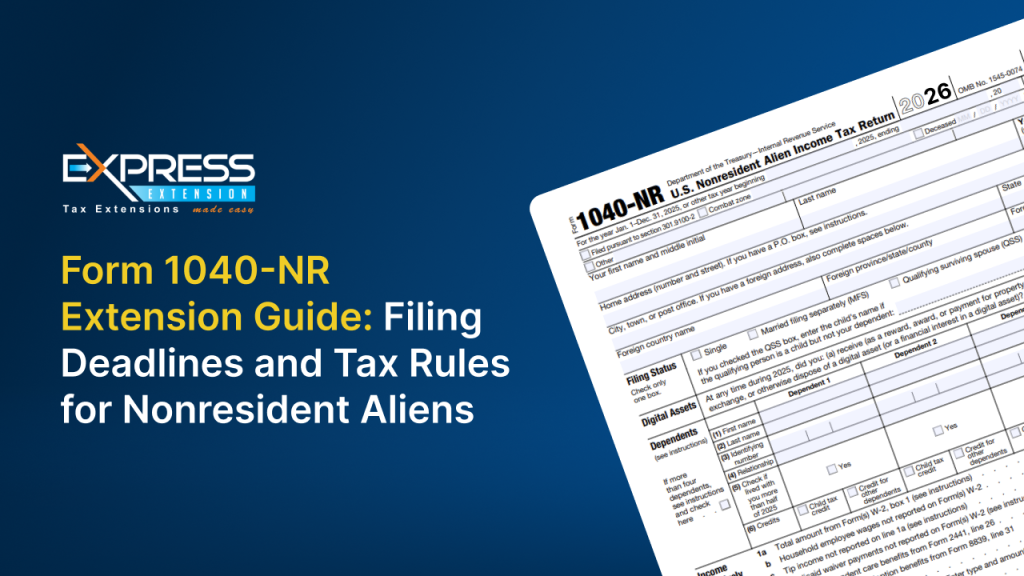
Living, studying, working, investing, or doing business in the U.S. as a nonresident can come with one very specific tax question: Do I need to file a U.S. tax return?
For many nonresident aliens, the answer depends on the type of U.S. income received during the year. Wages from a U.S. employer, taxable scholarship income, rental income, business income, gambling winnings, and other U.S.-source income may all create a filing requirement. And when that filing requirement applies, the return is usually Form 1040-NR, U.S. Nonresident Alien Income Tax Return.
But here is where it gets important: the Form 1040-NR deadline is not always the same for every nonresident alien. Some filers follow the April deadline, while others may have until June. If more time is needed, Form 4868 can help extend the filing deadline — but it does not extend the time to pay any tax due.
This guide breaks down what Form 1040-NR is, who it applies to, how the deadline works, and what nonresident aliens should know before filing an extension.
What is Form 1040-NR?
Form 1040-NR is used by nonresident aliens to report certain U.S. income to the IRS. Unlike U.S. citizens and resident aliens, who generally report worldwide income, nonresident aliens are generally taxed on U.S.-source income and income connected with a U.S. trade or business.
You may need to file Form 1040-NR if you had U.S. income during the tax year, had federal tax withheld, owe additional tax, or want to claim a refund of overwithheld tax.
Common examples include:
- Wages earned from a U.S. employer
- Taxable scholarship or fellowship income
- Income from a U.S. business or trade
- Rental income from U.S. property
- Gambling winnings from U.S. sources
- Certain investment income
- Income affected by tax treaty benefits
Even if tax was already withheld, filing may still be necessary — especially if you need to report income accurately, claim a refund, or apply treaty-based tax treatment.
Who is considered a nonresident alien?
A nonresident alien is generally someone who is not a U.S. citizen and does not meet the IRS rules to be treated as a resident alien for federal income tax purposes.
Residency for tax purposes is not always the same as immigration status. The IRS generally uses tests such as the green card test and substantial presence test to determine whether an individual is a resident alien or nonresident alien for tax filing purposes.
This distinction matters because it determines which tax form you file, what income is taxable, and which deductions, credits, and treaty rules may apply.
Form 1040-NR deadline: Why it can be April or June
The Form 1040-NR deadline depends on whether the nonresident alien received wages as an employee subject to U.S. income tax withholding.
- If you received wages subject to U.S. income tax withholding, your Form 1040-NR is generally due by the 15th day of the 4th month after your tax year ends. For calendar-year filers, this is usually April 15.
- If you did not receive wages as an employee subject to U.S. income tax withholding, your Form 1040-NR is generally due by the 15th day of the 6th month after your tax year ends. For calendar-year filers, this is usually June 15.
If the due date falls on a Saturday, Sunday, or legal holiday, the deadline generally moves to the next business day.
Can nonresident aliens file an extension for Form 1040-NR?
Yes. Nonresident aliens who need more time to file Form 1040-NR can generally request an automatic extension by filing Form 4868, Application for Automatic Extension of Time To File U.S. Individual Income Tax Return.
The extension request must be filed by the original due date of the return. That means April-deadline filers must file Form 4868 by the April due date, and June-deadline filers must file it by the June due date.
The extended deadline depends on the original due date:
- If the original Form 1040-NR deadline is April 15, the extended filing deadline is generally October 15.
- If the original Form 1040-NR deadline is June 15, the extended filing deadline is generally December 15.
There is also a key detail for June-deadline Form 1040-NR filers. If your return is due June 15 because you did not receive wages as an employee subject to U.S. income tax withholding, the IRS instructions say to check the box on line 9 of Form 4868.
An extension gives more time to file — not more time to pay
This is the rule many taxpayers miss.
Form 4868 extends the time to file Form 1040-NR. It does not extend the time to pay tax.
If you expect to owe U.S. tax, you should estimate your tax liability and pay the expected balance by your original deadline. Waiting until the extended deadline to pay may result in interest and possible penalties.
A practical extension process looks like this:
- Confirm whether your Form 1040-NR deadline is April 15 or June 15.
- Estimate your total U.S. tax for the year.
- Subtract federal tax already withheld or paid.
- Pay any expected balance due by the original deadline.
- File Form 4868 by the original deadline.
- File Form 1040-NR by the extended deadline.
Need extra time to file Form 1040-NR?
ExpressExtension makes it simple to request an extension for Form 1040-NR by filing Form 4868 online. Whether your regular due date is in April or June, you can complete your extension request in minutes and transmit it securely to the IRS.
Leave a Comment